
DNA testing is a highly accurate way to confirm family links. While many people use these tests for their own information, others need them for official reasons. When a biological relationship needs to be proven for a judge or a government office, a standard home test is not enough.
This is where legal DNA tests in India become necessary. These specific tests follow a strict process to ensure the DNA test results are trustworthy and can be used as proof in important legal matters, such as property claims or child custody cases.
What are Legal DNA Tests in India, and How Do They Work?
A legal DNA test is an official procedure used to validate the genetic links between two or more individuals involved in court-related disputes. Unlike a peace of mind test, which can be done privately at home, a legal test must follow a set of strict rules called the chain of custody. This process ensures that the samples collected belong to the right people and have not been changed or tampered with at any point.
The Chain of Custody Process
The chain of custody is the backbone of any legal test. It involves several careful steps:
- Identity Verification: Every person taking the test must show a government-issued ID to prove they are who they say they are.
- Professional Supervision: The samples are collected by a lab expert while a court-appointed official or representative watches the process.
- Secure Sealing: Once the samples are taken, they are placed in a tamper-proof package and sealed immediately in front of the official.
- Direct Transport: The sealed samples are sent directly to the laboratory for analysis to prevent anyone from interfering with them.
Are DNA Tests Legal in India for Court Use?
Yes, DNA tests are absolutely legal and widely accepted in India. However, the court only accepts reports from laboratories that follow the legal procedure for DNA testing services in India. A judge will usually order a test when scientific proof is needed to settle a dispute.
Why Courts Trust These Tests
Courts rely on DNA evidence because it provides “undeniable evidence” of genetic links. Because the legal proceedings are so strict, the results are considered highly reliable. This is why they are often used in high-stakes cases where a person’s future or rights are being decided.
Situations Where Courts Request DNA Evidence
There are many reasons why a judge might ask for a DNA test:
- Child Custody and Support: To ensure a child is cared for by their true biological parents.
- Property Inheritance: To prove a person is a rightful heir to a family estate.
- Criminal Investigations: To help law enforcement identify or clear suspects in a crime.
- Identity Protection: To prevent issues like child trafficking or illegal adoptions.
How to Get a Legal DNA Test in India?
Getting a legal DNA test involves more than just booking an appointment; it requires following a specific path to ensure the results stay valid for the court.
Step 1: Court Order
Usually, the process starts when a judge orders a state or district laboratory to perform the test. However, government labs often have very long waiting lists, and it can take months to get an appointment. Fortunately, individuals can request to use a private laboratory of their choice, like the DNA Forensics Laboratory.
Step 2: Choosing an Accredited Laboratory
It is vital to choose a lab that holds the right certifications. Our DNA and forensics testing laboratory – Chimera Transplant Research Foundation (CTRF) is accredited by NABL accredited. Moreover, our reports are officially admissible in the honorable courts of law. Choosing a certified lab ensures that the high-quality standards required by law are met.
Step 3: Sample Collection
The most common method for collecting DNA is the “buccal swab” or cheek swab. A soft cotton swab is rubbed on the inside of the cheek to collect skin cells. This is a painless and safe procedure for people of all ages, including newborns.
Step 4: Confidential Reporting
In a legal case, the final report is handled with extreme care to maintain its integrity. Instead of being sent to the people who took the test, the report is sent directly to the judge’s office or the embassy. This prevents anyone from seeing or altering the results before the court does.
Types of Family Links in Legal DNA Tests
There are several different types of tests available depending on the family relationship that needs to be proven:
| Test Type | Description |
| Paternity | Confirms the biological relationship between a father and child. |
| Maternity | Confirms the biological relationship between a mother and child. |
| Siblingship | Determines the genetic link between two or more individuals. |
| Grandparentage | Verifies a link between a grandparent and a grandchild. |
| Avuncular | Confirms the relationship between an aunt/uncle and a niece/nephew. |
Understanding the Costs of Legal DNA Tests
Legal DNA tests generally cost more than personal tests because they involve extra paperwork, identity verification, and professional supervision.
- Number of People: While most tests involve two people, adding more family members will increase the cost.
- Urgency: If a report is needed quickly for a court hearing, “express delivery” options can provide results in 24 to 48 hours for an additional fee.
- Type of Test: Specialized tests, such as those used for immigration or prenatal paternity (testing before a baby is born), have different pricing structures.
Why Choose DNA Forensics Laboratory Pvt. Ltd?
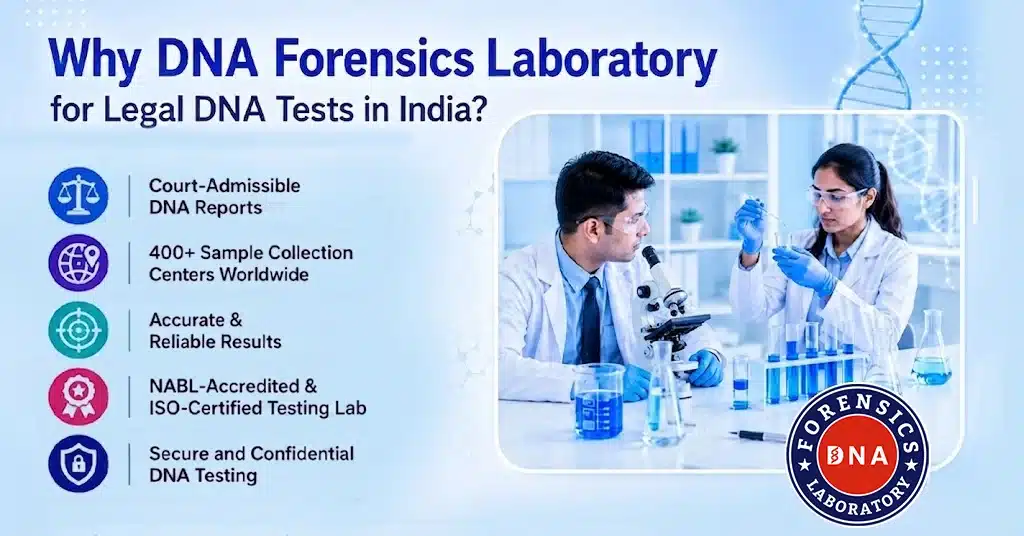
Using a laboratory like the DNA Forensics Laboratory, also called DFL, provides a reliable DNA testing procedure because they are highly experienced in handling Legal DNA Tests in India. With over 400 collection centers and advanced technology, they ensure that every step of the legal procedure for a DNA test in India is followed perfectly. This helps families resolve their disputes quickly and move forward with their lives with complete certainty.
DFL is the only private DNA testing company in India whose DNA test reports are legally admissible in the honorable courts of law. Additionally, we also provide DNA testing services for peace of mind and sponsored immigration.
For more information or to book a legal DNA test in India, call us at +91 8010177771. Alternatively, you can also send a message on WhatsApp at +91 9266615552.
Frequently Asked Questions
Q1. How long does it take to receive results from a legal DNA test in India?
It usually takes around 8-10 business days to receive the final report of a legal DNA test. This report is directly sent to the honorable hearing judge’s office.
Q2. What is the process for a court-ordered DNA test in India?
The honorable hearing judge appoints a representative who monitors the DNA sample collection process of a legal DNA test. Then the samples are securely sealed and sent to a lab for further analysis.
Q3. How much does a legal DNA test cost in India?
The cost of a legal DNA test ranges from 35,000 to 40,000 INR. However, this cost may vary depending on factors like the number of people in the DNA test. The type and complexity of the test are also considered.
Q4. How to choose a reliable legal DNA testing lab in India?
A reliable and trustworthy lab for legal DNA tests is one whose reports are legally admissible in the honorable courts of law. And DNA Forensics Laboratory is the only private DNA testing company in India whose reports are legally admissible for court-related disputes.
Q5. How to book an appointment for a legal DNA test in India?
You can call the experts of the DNA Forensics Laboratory at +91 8010177771 and schedule an appointment for your legal DNA test.
Q6. What are the legal requirements for a DNA test in Indian courts?
A strict chain of custody protocol, a lab whose reports are legally admissible in the honorable courts, and a DNA test performed under the supervision of a court official are mandatory requirements for legal DNA tests.

